What You See on a Cliffs of Moher Boat Tour, Point by Point
From the water the cliffs read as a wall, not a viewpoint. Here is every named feature the boat passes, in the order the crew points it out.
Short answer
The Doolin cruise runs along the base of the cliff wall, which climbs to 214 metres near O'Brien's Tower. You pass the 67-metre An Branan Mor sea stack, the sea cave used in a Harry Potter film near Hag's Head, and the seabird colonies. Puffins are present from late March to mid-July.
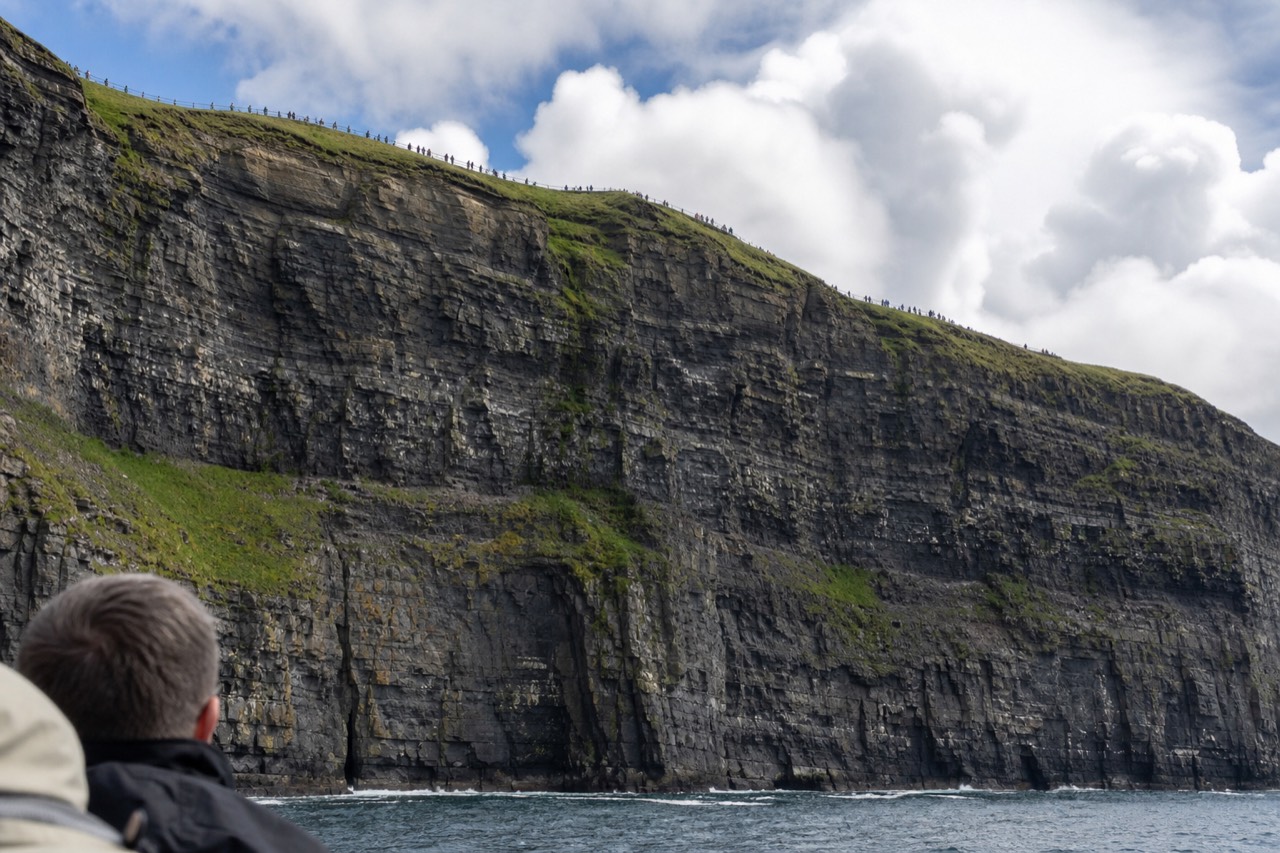
Stand at the clifftop rail and you look down a long green drop to a thin line of surf. Push off from Doolin Pier and run south under the same cliffs, and the view flips: the wall climbs out of the water above your head, banded in dark rock, and the people at the rail shrink to specks on the skyline. That inversion is the whole reason the boat trip exists. It shows you the Cliffs of Moher as a height rather than an edge, and it puts named features in front of you that no path reaches.
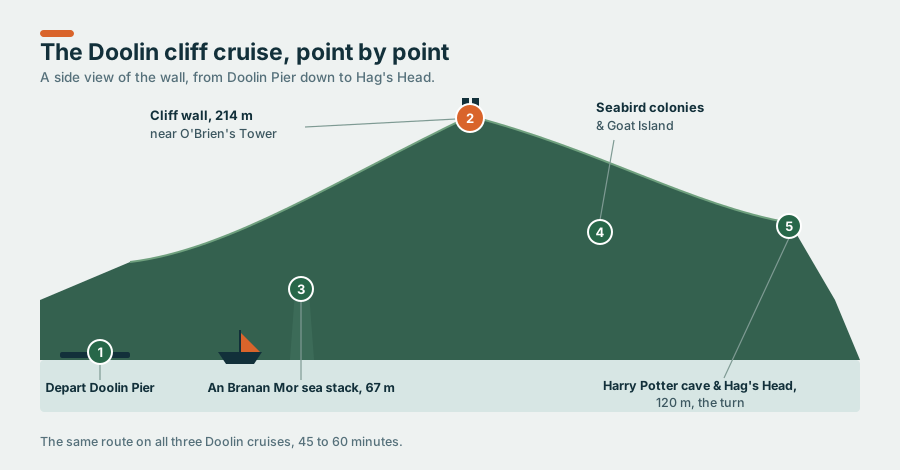
The cruise from Doolin runs roughly 45 minutes to an hour, tracking the most dramatic central section of the cliffs to the south and back to the same pier. The crew works through the landmarks in order, with live commentary and a downloadable audio track in several languages. This guide follows that same order, feature by feature, so you know what you are looking at and where to look for it before the boat even leaves the harbour.
Prices and review counts quoted in the editorial below are earlier planning snapshots, not live quotes. Check the booking option for your date, currency and party before comparing totals.
What do you actually see on a Cliffs of Moher boat tour?
The boat runs the base of the cliff wall from Doolin Pier, passing, in order: the layered rock face rising to 214 metres near O'Brien's Tower, the 67-metre An Branan Mor sea stack, the sea cave and arch used in a Harry Potter film near Hag's Head, and the seabird colonies on the ledges. Puffins are present from late March to mid-July. Dolphins and seals are possible, never promised.
Everything you see is from sea level, looking up. That single fact reorders the cliffs into a sequence of features you pass rather than a single panorama you scan. The wall itself is the constant, always there off one side of the boat, while the stack, the cave and the bird colonies arrive one after another as the crew names them. The table below is the whole route in one glance, and the sections after it take each feature in turn.
| On the water | What it is | Where to look |
|---|---|---|
| The cliff face | Layered rock rising to 214 m near O'Brien's Tower | Straight up, off the side as you reach the wall |
| An Branan Mor | A 67 m sea stack split from the cliff by erosion | At the base below O'Brien's Tower |
| The sea cave and arch | The cave used in Harry Potter and the Half-Blood Prince | Near Hag's Head, the southern turn |
| Aill na Searrach | The big-wave surf break known as Aileen's | Below the southern cliffs, on a swell |
| Seabird colonies | Puffins in season, plus guillemots, razorbills, kittiwakes, fulmars | The grassy ledges and Goat Island |
| O'Brien's Tower | The round 1835 tower on the highest clifftop | On the skyline above, seen from below |
| Hag's Head | The southern headland, 120 m, with a ruined tower | The far end of the run before the boat turns |
This site, Cliffs of Moher Cruises, compares the real, currently bookable listings that run this route, and the honest note up front is that Doolin cliff cruises show you the same features. They differ on duration, review count and price transparency, not on what passes the rail. Here are the three side by side before we work through the wall itself.
How big is the cliff face from the water?
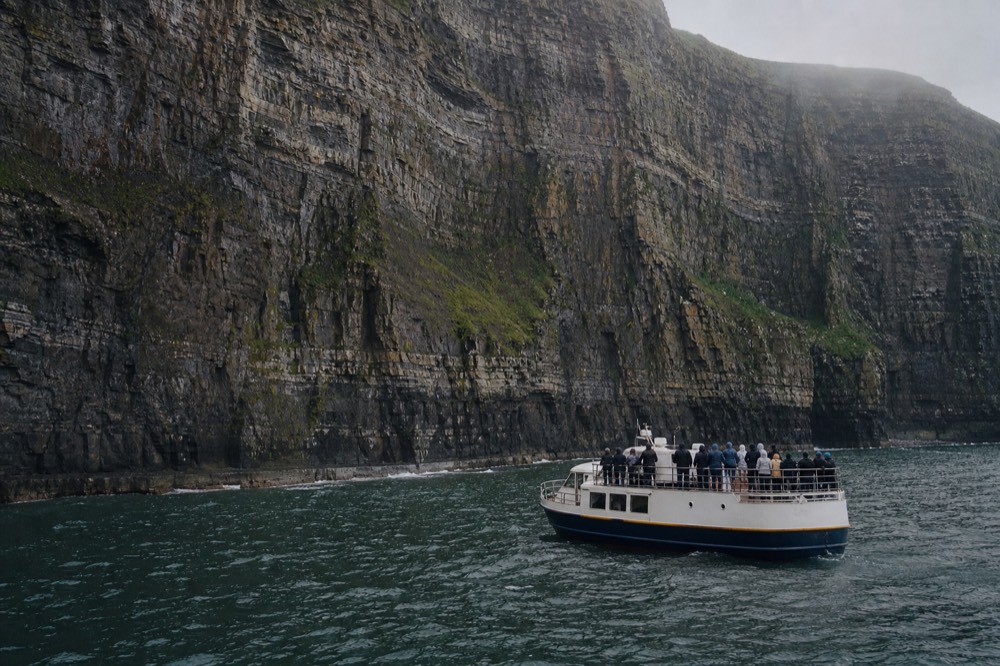
The cliffs reach 214 metres, about 702 feet, at their highest point near O'Brien's Tower, and taper to 120 metres at Hag's Head in the south. From the water that height reads far bigger than it does from the top, because you see the whole vertical face at once. The rock is layered Carboniferous shale and sandstone, laid down more than 300 million years ago, with the oldest beds at the waterline.
Scale is what the boat delivers that the clifftop cannot. From above, 214 metres is a number and a drop you keep back from. From below, it is a wall filling the sky, with the horizontal bands of rock stacked like the pages of a book and the clifftop visitors reduced to dots along the rail. The highest section sits at Knockardakin, just north of O'Brien's Tower, and the cliffs run around 14 kilometres along the coast, though the cruise concentrates on the tallest, most sheer central stretch.
| Feature | Height or figure | Note |
|---|---|---|
| Highest point, near O'Brien's Tower | 214 m (702 ft) | At Knockardakin, the tallest section |
| Hag's Head, southern end | 120 m (390 ft) | The lower headland where the boat turns |
| An Branan Mor sea stack | 67 m (about 220 ft) | Free-standing at the foot of the wall |
| Rock strata exposed | Up to about 200 m | Namurian shale and sandstone beds |
| Age of the rock | More than 300 million years | Carboniferous, oldest at the base |
The geology is worth a glance because the boat brings you close enough to read it. The dark bands are compressed mud and sand from an ancient river delta, and the whole coast forms part of the Burren and Cliffs of Moher UNESCO Global Geopark, designated in 2011. Up close you can see the erosion at work, the undercut base, the fallen blocks, the caves the sea has bored into the softer layers. The Cliffs of Moher entry is the primary reference for the heights and the geology if you want the full detail.
What is An Branan Mor, the sea stack?
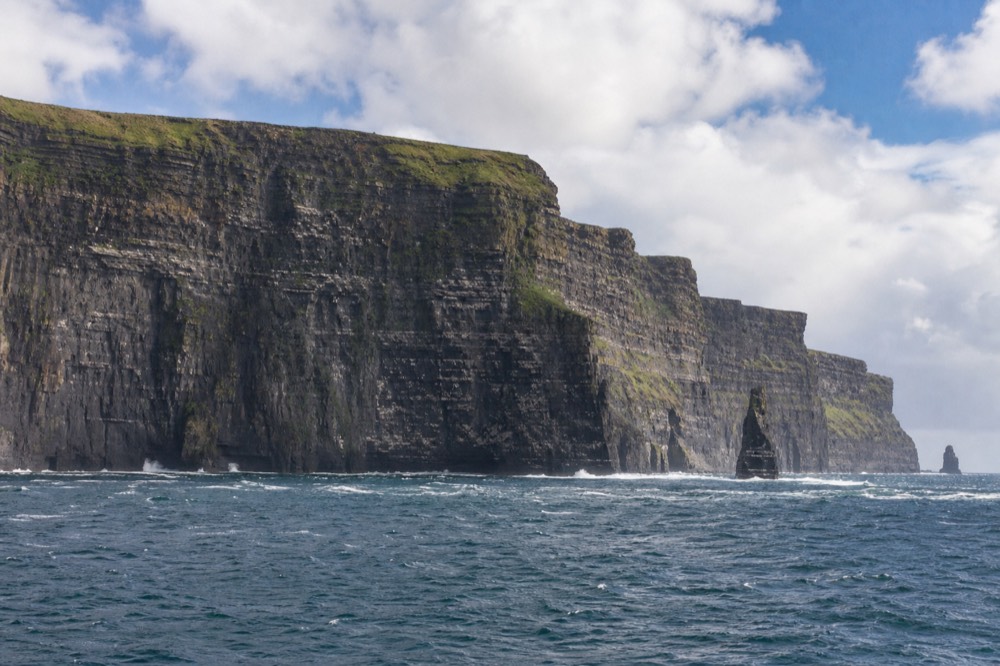
An Branan Mor, also called An Branaunmore, is a free-standing sea stack about 67 metres high at the foot of the cliffs below O'Brien's Tower. Erosion split it from the mainland, and the sea keeps working on it: erosion continues to shape the stack. It carries one of the largest mainland seabird colonies on the coast, with tens of thousands of pairs, and the crew slows the boat here for the birds.
The stack is the single most photographed feature on the cruise, and the reason the boat lingers at the base of the wall rather than just running past it. It stands offshore like a rough pillar of the same layered rock, once joined to the cliff and now cut off, streaked white with the guano of the colony that packs its ledges. In the puffin months the sound and the smell of the birds reach the boat before the crew has finished the sentence introducing it.
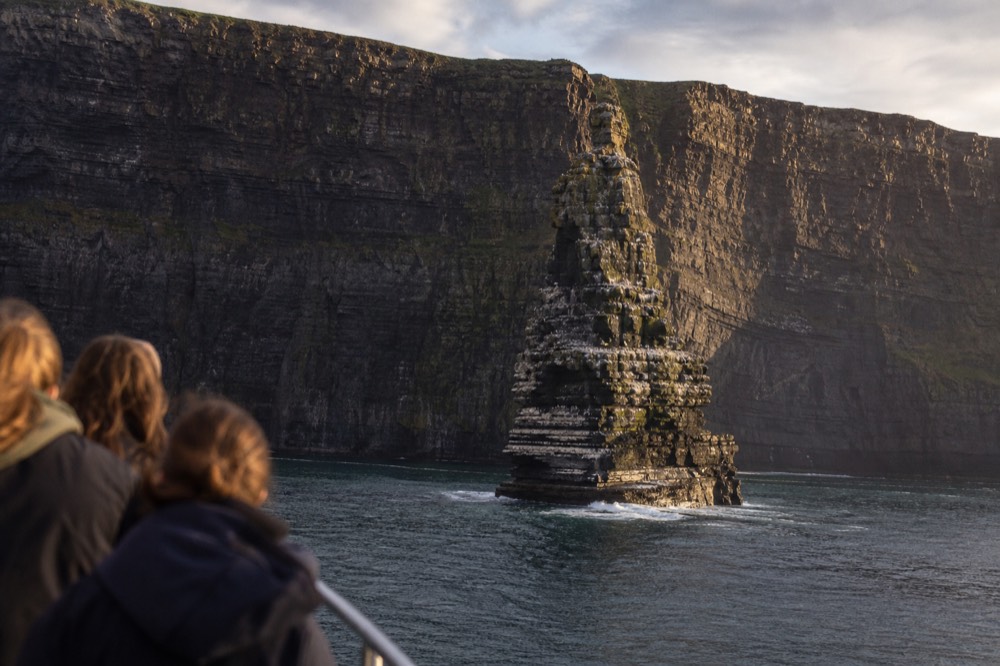
The stack is also a live illustration of how these cliffs are made, by the sea taking the coast apart piece by piece. The eroded shape of the stack is a reminder that the feature you photograph is not permanent, and that the same erosion that separated it from the mainland is still going. None of that changes the trip, but it does make the point that the cliffs are geology in motion rather than a fixed monument. For a full account of the wildlife on those ledges, our puffin and seabird calendar covers the species and the timing in detail.
Where is the Harry Potter sea cave?
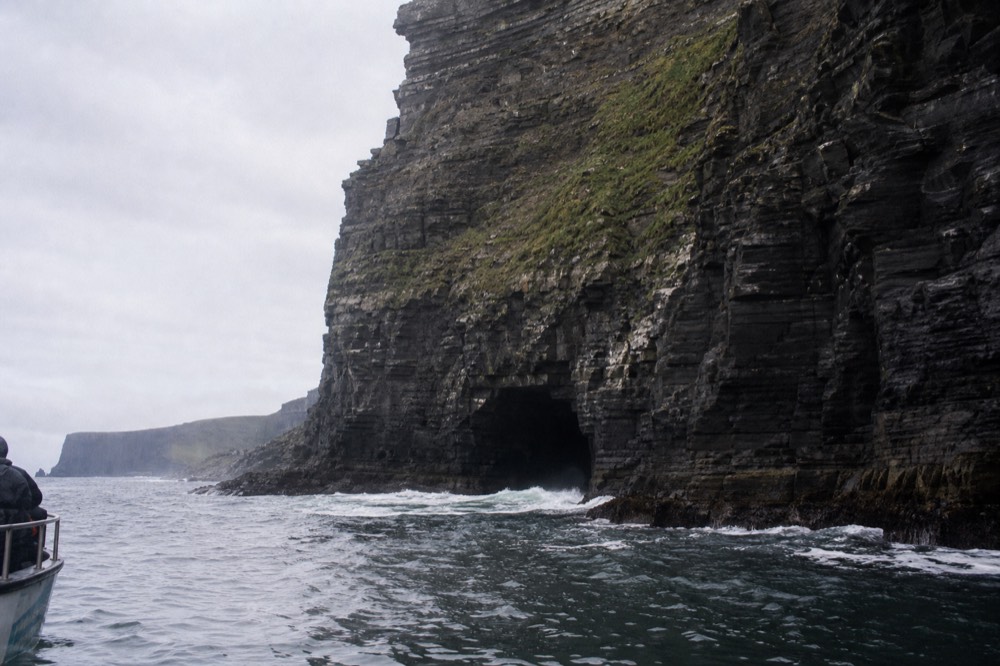
Near Hag's Head, at the southern end of the cruise, the boat passes the dark sea cave and arch used as a filming location in Harry Potter and the Half-Blood Prince. The crew points it out as the boat reaches the turning point of the run. Close to it is Aill na Searrach, the reef that produces Aileen's, the big-wave surf break, which shows its power only on a heavy Atlantic swell.
The cave is a highlight for the pop-culture value and for the geology both. It is a genuine sea cave cut into the base of the cliffs, its mouth a tall dark slot in the rock, and it appeared on screen as the cave the film's characters reach by boat. Seeing it from the water is the only way to see it as the film did, from sea level looking in, which the clifftop path cannot offer at all. The commentary usually flags it a moment before it comes abeam, so keep your camera ready as the boat nears the southern cliffs.
| Southern-end feature | What it is | When you see it |
|---|---|---|
| The Harry Potter cave | Sea cave from Harry Potter and the Half-Blood Prince | Near Hag's Head, at the turn |
| Sea arch | A natural arch cut by the waves | Alongside the cave section |
| Aill na Searrach, Aileen's | The reef behind Ireland's best-known big wave | On a big swell, below the cliffs |
| Hag's Head | The 120 m southern headland with a ruined tower | The far point before the boat returns |
Beyond the film connection, the southern cliffs are where the boat turns and heads back, so this stretch is your last close pass before the return leg to Doolin. On a day with a serious swell running, the Aill na Searrach reef nearby can be breaking, and while the cruise never goes near the surf itself, seeing the size of the water there tells you plenty about why the operator cancels sailings when the Atlantic gets big. The story of the cliffs on film is a light read in our piece on what "Moher" means and the movies filmed here.
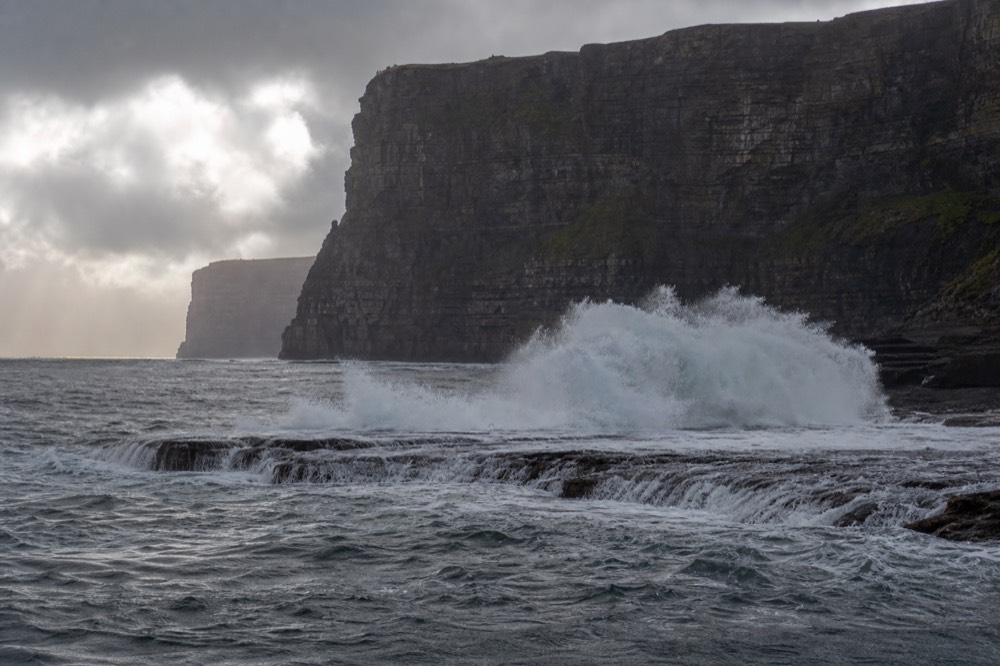
What seabirds and wildlife will you see?
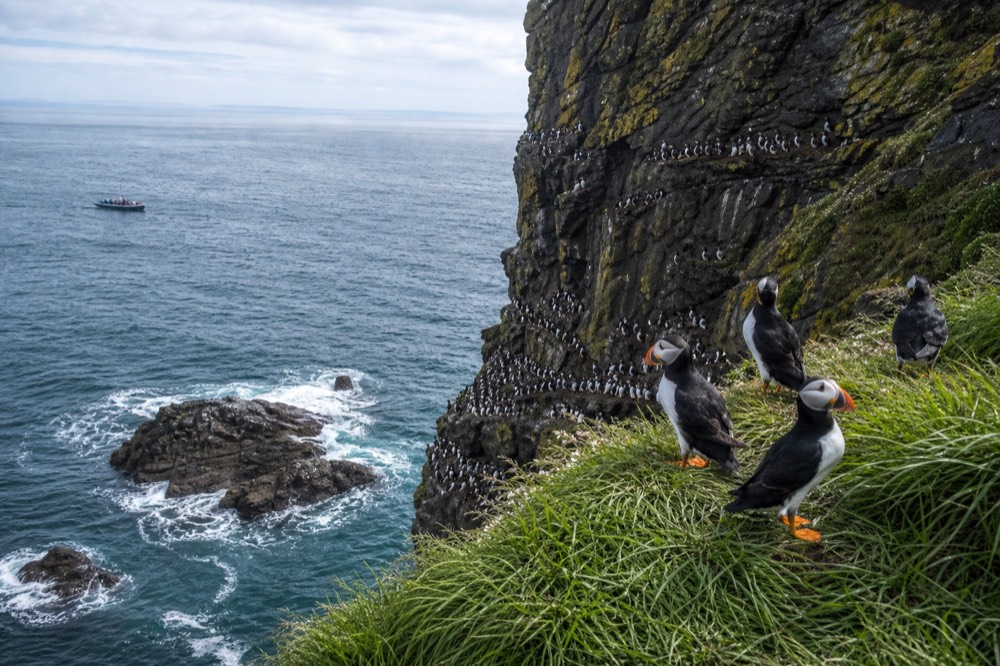
In season the cliffs hold one of Ireland's major seabird colonies, more than 30,000 pairs across the ledges. Atlantic puffins are present from the end of March to mid-July, best in May and June, nesting on the grassy slopes and on Goat Island. Guillemots, razorbills, kittiwakes and fulmars are on the rock through the season. Dolphins, grey seals and, rarely, a basking shark are possible but not guaranteed.
Wildlife is a bonus layered on top of the geology, and the density of it surprises most first-timers. The ledges are busy with nesting birds through the sailing season, wheeling off the rock as the boat passes and settling again behind it. The puffins are the draw, small and comic with their bright beaks, and they cluster on the grassy slopes near the sea stack. Outside their window the auks and gulls still line the cliffs, so the colony is never empty in season, only quieter of its star attraction. That comic appeal makes the birds a highlight for the youngest passengers, and a cliffs cruise with young children has practical points worth reading before you board.
| Wildlife | When to look | How likely |
|---|---|---|
| Atlantic puffins | End of March to mid-July, best May to June | Possible during the breeding season |
| Guillemots and razorbills | Across the sailing season | Best looked for during the breeding season |
| Kittiwakes and fulmars | Across the sailing season | Presence varies with season and conditions |
| Grey seals | Any month | Occasional, not guaranteed |
| Dolphins | Any month | Possible, luck of the day |
| Basking sharks, minke whales | Mostly summer | Rare, treat as a bonus |
The colony figures come from long-running seabird counts, and the National Parks and Wildlife Service is the source for the protected-site data on the fulmars, kittiwakes and guillemots that share the cliffs with the puffins. Marine mammals are the true wildcard: bottlenose and common dolphins turn up on some sailings, grey seals haul out below the cliffs, and on rare summer days a basking shark or a minke whale passes, but the operators are careful to frame all of that as possible rather than part of the ticket. Binoculars earn their place in the bag for the birds especially.
A full day on the water raises the odds of the marine wildlife simply through hours at sea.
Do you pass O'Brien's Tower and Hag's Head?
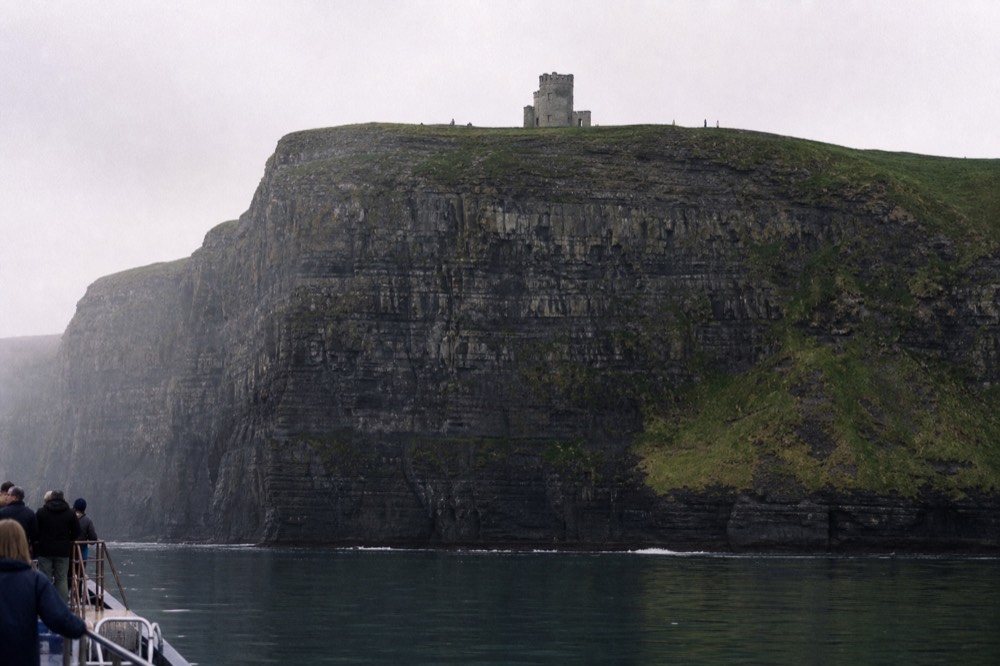
You pass beneath both, seen from below rather than visited. O'Brien's Tower is the round stone tower built in 1835 by Cornelius O'Brien on the highest clifftop, standing on the skyline above the sea stack. Hag's Head is the 120-metre southern headland with the ruin of an old tower, marking the turn of the cruise. Neither is a stop; both are clifftop features the boat views from the water.
This is where the sea-level perspective is at its most striking. O'Brien's Tower, the little round lookout most visitors climb from the clifftop, sits far above you on the very highest point, and from the boat it is a small silhouette on the edge of a 214-metre drop. Hag's Head, at the southern end, carries the ruin of Moher Tower and gives the cliffs their name, from the Irish for the ruin of a fort that once stood there. Seeing both from below is a different relationship to the landmarks than walking up to them.
| Clifftop landmark | What it is | How you see it from the boat |
|---|---|---|
| O'Brien's Tower | Round stone tower, built 1835 | A silhouette on the highest clifftop |
| Knockardakin | The 214 m high point near the tower | The tallest section of wall above you |
| Goat Island | The grassy slope of the puffin colony | Below the tower, near the sea stack |
| Hag's Head | 120 m southern headland with Moher Tower ruin | The turning point of the cruise |
The takeaway is that the cruise and the clifftop show you the same landmarks from opposite ends. From the top you stand at O'Brien's Tower and look down; from the boat you sit at the waterline and look up at it. Many visitors do both for exactly that reason, and our guide comparing the cruise with the clifftop visitor centre sets out how the two experiences differ and why they pair so well.
What does the cruise not show you?
The cruise does not include the clifftop. It is a sea-level trip only, with no landing at the Cliffs of Moher Experience visitor centre, which sits about 8 km away by road and needs a separate land ticket. You do not walk the paths, climb O'Brien's Tower or see the interpretive exhibits from the boat. What you gain is the height and the features from below; what you give up is the long clifftop view and the walk.
This is the single most common point of confusion at Doolin Pier, so it is worth stating plainly. A cruise ticket buys you the boat trip and nothing on land. The clifftop Experience is a different attraction, run separately, roughly 8 km from the pier, and it is the one that recorded just over 1.5 million visitors in 2025, which made it Ireland's second most-visited attraction. That figure belongs to the land site, not the cruise.
| The Doolin boat cruise | The clifftop visitor centre | |
|---|---|---|
| Vantage | Sea level, looking up the wall | Clifftop, looking down and along |
| You see | The stack, the cave, the colonies from below | O'Brien's Tower, the paths, the long view |
| Access | Boat from Doolin Pier | Separate land ticket, about 8 km away |
| Time | 45 to 60 minutes on the water | An hour or two on foot |
| Weather | Cancellable in Atlantic swell | Subject to weather and safety restrictions |
If a landing on an island appeals more than a straight out-and-back, the Doolin trip that adds Inis Oírr keeps every cliff feature above and folds in an Aran island as well.
How do you photograph the cliffs from the boat, and which side should you sit?
Both sides of the boat get good angles, because the route curves and the boat turns, so seat choice matters less than being ready when the crew names each feature. For the cliff face lit rather than in shadow, a midday or early-afternoon return puts the sun behind you. A moderate lens around 35 to 50 millimetres keeps the scale honest, since wide angles shrink the wall. Bring a cloth for the salt spray.
Photographers overthink the seat and underthink the light. Because the cruise runs out along the cliffs and back, and slows and turns at the sea stack and the cave, every passenger gets a clear view of the main features at some point. The better lever is timing: a return sailing around the middle of the day throws the sun onto the cliff face rather than behind it, so the rock is lit and the layers show. A golden-hour sailing does the opposite, silhouetting the wall for a more dramatic, darker frame.
| Photography tip | Why it helps |
|---|---|
| Sail a midday or early-afternoon return | Puts the sun behind you, lighting the cliff face |
| Use a 35 to 50 mm equivalent lens | Keeps the scale realistic; wide angles shrink the wall |
| Do not worry too much about which side | The route curves and turns, so both sides get angles |
| Bring a microfibre cloth | Salt spray coats the lens quickly at the cliff base |
| Pack binoculars | The seabirds and the stack colony reward a closer look |
The one thing no setting fixes is a rough grey day, when the light is flat and the boat is moving too much for sharp frames. That is another argument for a calm morning or a bright midday slot, covered in full in our guide to the best time to sail. For the whole experience laid out from the pier onward, the Doolin cliff cruise and boarding guide walks through the boats and the boarding, and the blunt is the boat tour worth it weighs the hour against the fare.
Frequently asked questions
What do you see on a Cliffs of Moher boat tour?
From the water you see the cliff face rising to 214 metres near O'Brien's Tower, the 67-metre An Branan Mor sea stack, the sea cave used in a Harry Potter film near Hag's Head, and the seabird colonies on the ledges. Puffins are present from late March to mid-July. It is a sea-level view of the whole vertical wall, an angle the clifftop path cannot offer.
How high are the Cliffs of Moher from the boat?
The cliffs reach 214 metres, about 702 feet, at their highest point near O'Brien's Tower, and drop to 120 metres at Hag's Head at the southern end of the cruise. From the water the full vertical face is in front of you at once, which makes the height read far bigger than it does looking down from the clifftop. The rock is layered shale and sandstone more than 300 million years old.
Can you see the Harry Potter cave from the cruise?
Yes. Near Hag's Head, at the southern turn of the cruise, the boat passes the sea cave and arch used as a location in Harry Potter and the Half-Blood Prince. The crew points it out as you reach that end of the run. Seeing it from sea level, looking into the cave mouth, is the only way to see it as it appeared on screen, which the clifftop path cannot do.
Will I see puffins on the cruise?
Only in season. Atlantic puffins are at the cliffs from about the end of March to mid-July, at their best in May and June, nesting on the grassy slopes and on Goat Island near the sea stack. Outside that window you still see guillemots, razorbills, kittiwakes and fulmars on the ledges. Dolphins and seals are possible on any sailing but never guaranteed.
Does the cruise include the clifftop visitor centre?
No. The cruise is a sea-level trip from Doolin Pier and does not include admission to the Cliffs of Moher Experience, the clifftop visitor centre about 8 km away. You see O'Brien's Tower and the clifftop from below, not from the paths. Many visitors do both, the boat for the height and the features and the clifftop for the long view and the walk, but neither ticket includes the other.
Choose the trip that fits your day
Starting recommendation • adjust it below
Doolin: 50-minute cliff cruise
Have a travel date in mind? Check it before arranging the rest of your trip. See the cliff wall, sea stack and sea cave from a boat departing Doolin Pier.
Return to Doolin Pier. Commentary and multilingual QR guide; check the language offered for your date. Parking and clifftop admission are separate. All ages welcome. Wheelchair access depends on harbour tides: contact the operator before booking.
Choose a date to check on GetYourGuide. Ticket options and availability are confirmed there.
Check dates: Doolin: 50-minute cliff cruiseCompare routes, tailor the choice & work out costs
- Doolin: 50-minute cliff cruise · 0.83 hours
- See the cliff wall, sea stack and sea cave from a boat departing Doolin Pier. Return to Doolin Pier. Commentary and multilingual QR guide; check the language offered for your date. Parking and clifftop admission are separate. All ages welcome. Wheelchair access depends on harbour tides: contact the operator before booking.
- Galway: Inisheer, cliff cruise & clifftop · 10 hours
- Coach connections, Inisheer island time and both cliff viewpoints in one day. Meet outside Kinlay Hostel, Merchants Road, for the 09:00 departure. English live guide. Return to Galway around 19:00; food and island activities cost extra. Infants sit on laps; contact the operator about access before booking.
- Galway City Docks: Inis Mór & cliff cruise · 8.5 hours
- Sail directly from Galway City Docks to Inis Mór, with a cliff cruise on the return. Arrive at the docks 30 minutes before departure; return to Galway. English audio guidance. Island transport, activities and parking cost extra. No clifftop visit; confirm mobility and child arrangements with the operator.
Route matching, not a suitability or weather guarantee. Check ages, child seats, language and boarding requirements for your party before paying.