What Does Moher Mean, and Which Films Were Shot at the Cliffs?
What the name Moher really means, the ruined fort behind it, the films shot at the Cliffs of Moher including Harry Potter and The Princess Bride, and how to see the locations from the water.
 By Niamh O'Connor, Cliffs of Moher & Doolin boat-cruise specialist
The name sounds soft and green, the kind of word that could mean "mist" or "meadow." It does not. "Moher" comes from an old Irish word for a ruined fort, a blunt, practical name for a place that was once about defence rather than scenery. And the cliffs it names have spent the last few decades doubling as somewhere else entirely: a wizard's hiding place, a fictional coastline in a fairy tale, a backdrop that film crews keep coming back to.
Those two threads, the ancient name and the modern camera, are more connected than they look. Both point at the same handful of landmarks along the cliff face, and the best way to see most of them is not from the fenced clifftop but from the water, where the fort site, the film cave and the full height of the rock line up in a single hour. This is a lighter piece than most on the site, but the cruise at the end of it is real.
Prices and review counts quoted in the editorial below are earlier planning snapshots, not live quotes. Check the booking option for your date, currency and party before comparing totals.
What does "Moher" mean?
"Moher" comes from the old Irish word "Mothar," meaning "the ruin of a fort." The cliffs are named after a promontory fort that once stood at Hag's Head, the southern tip of the cliff line. So the full name, Cliffs of Moher, translates loosely as the cliffs of the ruined fort, a reference to a structure that vanished long before the modern visitor centre existed.
It is a name rooted in the landscape's history rather than its beauty, which is fitting for a coast this exposed. The fort would have used the natural defences of the headland, sheer drops on three sides, to guard the approach along the cliffs. Over time the fort fell to ruin, but the name stuck, attaching itself to the whole 8-kilometre stretch of cliff that runs along this part of the Clare coast. The official cliffs site records the derivation from Mothar and the fort at Hag's Head.
Names like this are common along the Irish coast, where headlands and forts left their mark on the map long before tourism arrived. What is unusual here is how completely the fort itself has vanished while its name has spread to cover the whole cliff line, a single promontory defence lending its title to one of Ireland's most visited natural sights. The gap between the blunt meaning and the grandeur of the place is part of what makes the name worth knowing.
Pronunciation trips up a lot of visitors. "Moher" is said roughly as "moor," a single soft syllable, not "mo-her." Getting the name and its meaning straight is a small thing, but it changes how you see the place: not just a pretty wall of rock, but a coastline people have watched, named and defended for a very long time. The cruise crews often mention it as the boat passes Hag's Head, where the story begins.
The Doolin cliff cruise options all sail past Hag's Head and the film locations on shared boats run by the Doolin Ferry Company group. Which one you pick comes down to sailing times and how long you want on the water, not the view, since they all cover the same stretch of coast. The name and the movies live along that same run, which makes the boat the natural way to see both.
Where does the name come from, and what was the fort?
The fort was a promontory fort at Hag's Head, the southern end of the cliffs, giving the whole coast its name from the Irish "Mothar." A later stone watchtower, Moher Tower, was built on roughly the same spot and still stands today. The original fort was demolished in the early 1800s, but its name outlived it by two centuries and counting.
Hag's Head is the quieter, wilder end of the cliffs, well south of the busy visitor centre. Its Irish name, Ceann na Caillí, ties to a local legend about a hag or witch, and the headland's shape has long drawn stories. The promontory fort that once crowned it is the "Mothar" of the name, a defensive site using the cliffs as walls, of the kind found on exposed headlands all along Ireland's Atlantic coast.
Hag's Head sits at the southern limit of the cliffs, the far end from Doolin, which is why it feels remote even by the standards of this coast. Its Irish name and its legends have made it a place apart in local storytelling, and the fort that once stood there would have commanded a long view over the sea approaches. Standing at that end today, ruin or not, it is easy to see why people built here and why the name attached itself to the whole stretch.
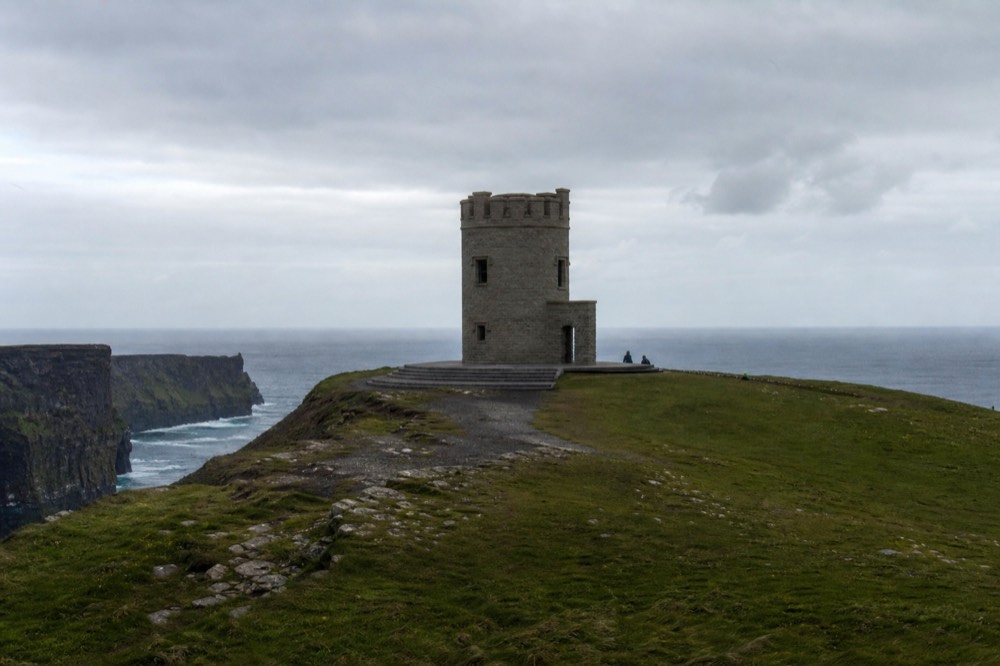
What you see there now is Moher Tower, a squat stone signal tower built in the early nineteenth century after the older fort was cleared away. From the clifftop it is a long walk south to reach it, which is why many visitors never do. From the water, though, Hag's Head and its tower are simply part of the run, the point where the Doolin cruise usually turns before heading back. Our guide to what you see on the cruise, point by point maps the landmarks from Doolin down to Hag's Head.
Which films were shot at the Cliffs of Moher?
Two films made the cliffs famous on screen. Harry Potter and the Half-Blood Prince, released in 2009, filmed the Cliffs of Moher for the dramatic approach to the Horcrux sea cave, though the cave interior itself was a studio set finished with visual effects. The Princess Bride, from 1987, filmed its "Cliffs of Insanity" here. Both leaned on the raw drama of the rock wall, and the cliff scenery they used reads best from the water.
The cliffs earn their screen time honestly. There is no set dressing that beats a 214-metre wall of layered rock rising straight out of the Atlantic, and directors have used it exactly as it is. The two productions that visitors ask about most are the Harry Potter film and The Princess Bride, and between them they draw on the sea caves at the cliff base and the wild headland at Hag's Head to the south.
| Film | Year | What was filmed here | See it from the cruise? |
|---|---|---|---|
| Harry Potter and the Half-Blood Prince | 2009 | The cliff exteriors for the Horcrux cave approach (the interior was a studio set) | Yes, the cliffs and their sea caves are seen from the water |
| The Princess Bride | 1987 | The "Cliffs of Insanity" | Yes, along the Hag's Head stretch |
Both films drew on angles the average visitor cannot easily reach on foot. The sea caves that the Harry Potter cave scene evokes sit at the base of the cliffs, invisible from the clifftop path above them. The stretch used for The Princess Bride runs toward the wild southern headland. That is the recurring theme of this piece: the cliffs' most cinematic details are down at sea level, which is precisely where a cruise takes you. The Cliffs of Moher entry on Wikipedia catalogues the film appearances alongside the geology.
What both productions understood is that the cliffs need no exaggeration. A film can lean on a set or a painted backdrop to sell a sense of danger, but here the drama is real: the drop, the swell at the base, the sheer scale of the wall. That authenticity is exactly why the locations hold up when you visit, and why recognising a spot from the water carries a small jolt that a studio backlot never could.
Where is Harry Potter's Cave, and can you see it?
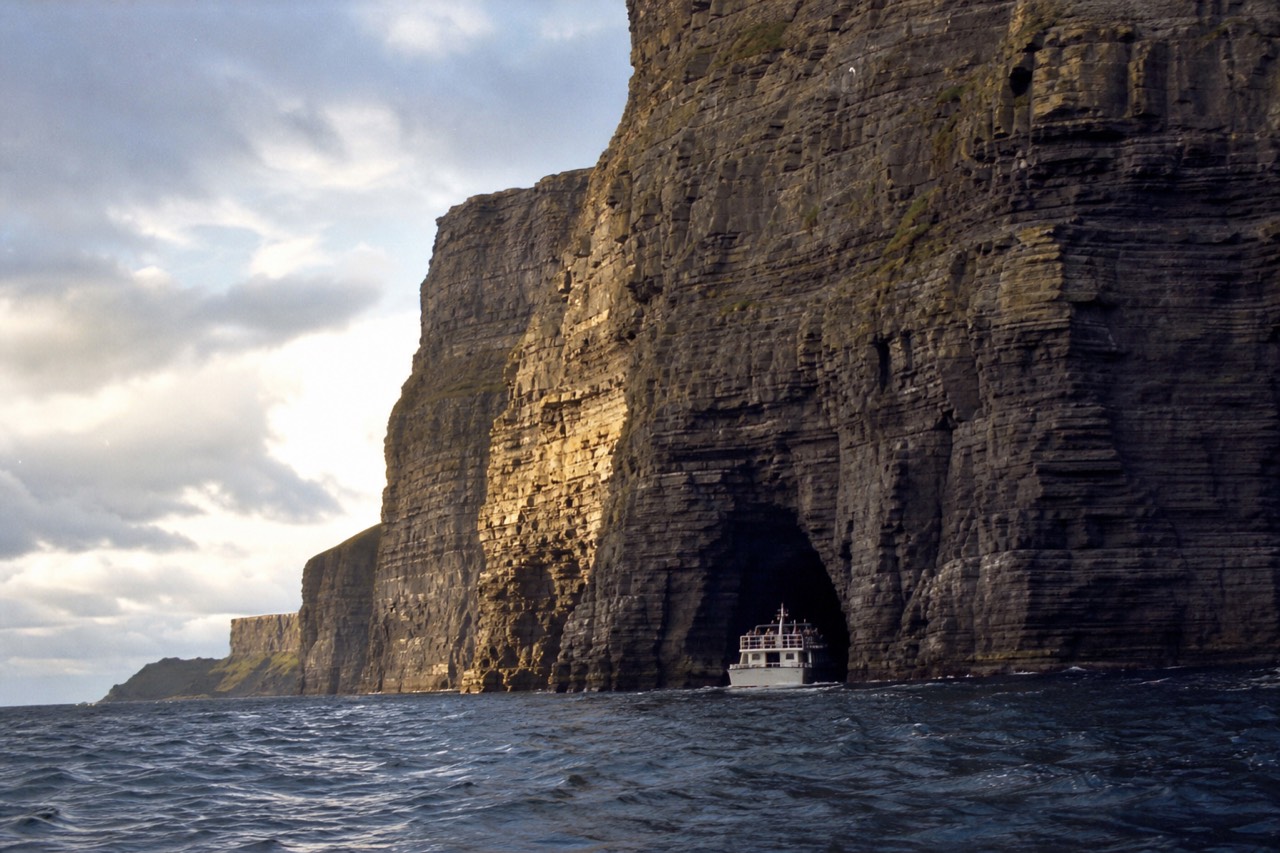
There is no single walk-in "Harry Potter cave" at the Cliffs of Moher. The Half-Blood Prince used the cliffs for the dramatic exterior approach, while the Horcrux cave interior was built as a studio set and finished with visual effects. What is real is the run of sea caves cut into the base of the cliffs, at sea level and hidden from the clifftop paths above. The Doolin cliff cruise passes them from the water, the same low, dramatic angle the film's exterior shots used.
This is the detail that surprises people. In the film the characters arrive by boat at a sea cave, and while that cave interior was a set, the Cliffs of Moher supplied the towering exterior, and the real coastline is lined with exactly this kind of sea cave, cut into the rock face and opening onto the water. Stand at the clifftop railing and you are directly above them with no way to look in. Sit on the cruise and the boat runs along the base, giving you the same low, dramatic angle the film used.
The crews usually point the cave out as the boat approaches, along with the sea arch and the An Branan Mor sea stack nearby, so you know exactly what you are looking at. It is one of the moments passengers most often mention afterward, the small thrill of recognising a place from a film and realising you could only reach this view by sea.
The older Doolin2Aran listing for this same cruise covered the same cave and stack along the cliff face, but it is no longer bookable on Viator (confirmed deactivated, checked 2026-09-28); the operator, now trading as Doolin Ferry Company, sells the same run through its flagship listing.
Were the "Cliffs of Insanity" really filmed here?
Yes. The "Cliffs of Insanity" in The Princess Bride, the towering wall the characters scale early in the film, were filmed at the Cliffs of Moher in 1987. The production used the sheer scale of the real cliffs, particularly the dramatic southern stretch toward Hag's Head, so the fictional cliffs of the fairy tale are, in fact, this very coast.
For a film that invented so much, the cliffs were left to be exactly what they are. The name "Cliffs of Insanity" is pure fiction, but the rock face on screen is the genuine article, and fans of the film often recognise it the moment the boat rounds toward the higher sections. The 214-metre maximum height, reached just north of O'Brien's Tower, is why the wall reads as impossibly tall on camera without any exaggeration.
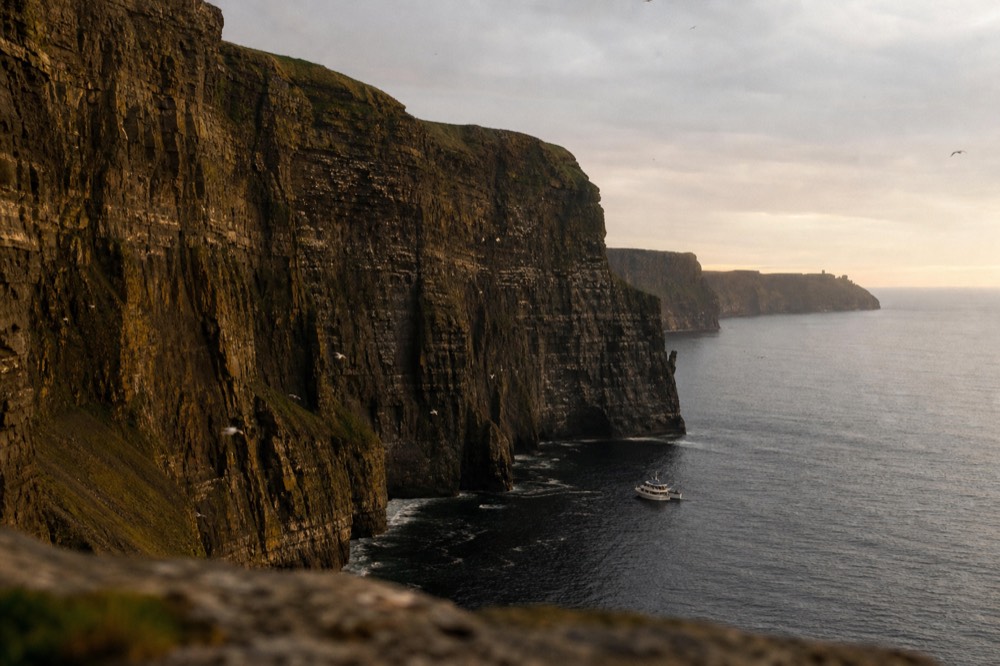
The cliffs have drawn film crews for decades precisely because they need no help. From the water, the same features that made them a natural set, the height, the sea stack, the caves and the wild southern headland, all come into view in a single sailing. Our look at whether the boat tour is worth it covers what that hour actually delivers beyond the film trivia.
What else can you see on the cruise besides the film spots?
Plenty. Beyond the movie locations, the cruise passes the full 214-metre height of the cliffs, the 67-metre An Branan Mor sea stack, sea caves and arches cut by the Atlantic, and one of Ireland's largest seabird colonies. You also see the layered rock formed some 320 million years ago, part of a UNESCO Global Geopark, from an angle the clifftop simply cannot offer.
The scale is the thing photographs never quite capture. From the water the wall climbs to its highest point, 214 metres just north of O'Brien's Tower, and the boat sits so far below it that passengers instinctively tilt their heads back. The An Branan Mor sea stack, 67 metres of rock that erosion split from the mainland, stands off the base like a marker of how the whole coast is slowly being cut away.
Then there is the life on the rock. In season the ledges are crowded with puffins, guillemots, razorbills, kittiwakes and fulmars, one of Ireland's major seabird colonies, and the crew usually slows near the stack where they gather thickest. The cliffs are part of the Burren and Cliffs of Moher UNESCO Global Geopark, recognised since 2011, and the bands of dark shale and sandstone you pass record more than 300 million years of history laid down layer by layer.
All of it comes from the same low vantage the films used, which is the quiet argument this whole piece has been building toward. The name points to Hag's Head, the movies point to the cave and the southern cliffs, and the geology and wildlife fill in everything between, but you only get the full set from the water. That is why the cruise, more than the clifftop, is where the story of the Cliffs of Moher comes together.
How can you see the film locations for yourself?
Take the boat. The Doolin cliff cruise runs along the base of the cliffs from Doolin Pier, past the Harry Potter sea cave, the sea arch, the An Branan Mor sea stack and the Hag's Head stretch used in The Princess Bride, all in roughly 45 minutes to an hour. The clifftop paths pass above these features but cannot show them, so the water is the way.
The route lines the locations up for you. Leaving Doolin, the boat tracks south along the wall, slowing near the sea stack where the birds are thickest, passing the cave and arch, and turning near Hag's Head before heading back to the same pier. In one short trip you cover the fort site that gave the cliffs their name and the two film spots that made them famous, without a long walk to reach any of them. Doing the same on foot would mean a long hike south along the clifftop to Hag's Head and no way at all to look into the sea cave, which is why the boat packs so much into so little time.
Seeing it this way also puts the film scenes in their real setting rather than a cropped shot. On screen the cave and the cliffs are framed for drama; from the boat you get the whole context, the birds wheeling off the ledges, the layered rock running for miles, the Atlantic that cut every cave and arch you pass. It turns a piece of movie trivia into an hour that stands on its own, film fan or not.
The season runs from 28 February to 1 November, weather permitting, with several departures a day in the core months. Because the sailing is weather-dependent, booking a calm morning gives the steadiest ride and the clearest look at the cave and the stack. The honest broker view from Cliffs of Moher Cruises is that the film trivia is a lovely bonus, but the real reason to sail is the perspective: the height, the texture and the caves that no clifftop view can offer. Our guide to the Doolin cliff cruise and boarding guide helps you choose which sailing to book, and the operator's Doolin Ferry timetable lists the 2026 departure times.
Frequently asked questions
What does the name Cliffs of Moher mean?
"Moher" comes from the old Irish "Mothar," meaning "the ruin of a fort," after a promontory fort that once stood at Hag's Head, the southern end of the cliffs. So the name translates loosely as the cliffs of the ruined fort. The fort is long gone, but a later stone watchtower, Moher Tower, still stands near the same spot. The name is said roughly like "moor."
Which films were shot at the Cliffs of Moher?
The two best known are Harry Potter and the Half-Blood Prince, released in 2009, which used a sea cave in the cliffs, and The Princess Bride, from 1987, which filmed its "Cliffs of Insanity" here. Both used the raw scale of the real cliff wall. The filming spots sit at the base and the southern end, best seen from the water on a cliff cruise.
Can you see the Harry Potter cave at the Cliffs of Moher?
Yes, but only from the water. The sea cave used in Harry Potter and the Half-Blood Prince is cut into the base of the cliffs near Hag's Head and opens onto the sea, so it cannot be seen from the clifftop paths above it. The Doolin cliff cruise passes the cave from below, which is the practical way most visitors get to see the actual location.
Were the Cliffs of Insanity really the Cliffs of Moher?
Yes. The "Cliffs of Insanity" scene in The Princess Bride was filmed at the Cliffs of Moher in 1987, using the sheer height of the real cliffs, especially the dramatic southern stretch toward Hag's Head. The name is fictional, but the rock face on screen is genuine. Fans often recognise it from the boat as the cruise passes the taller sections of the wall.
What is the best way to see the film locations?
Take the Doolin cliff cruise. It runs along the base of the cliffs from Doolin Pier, past the Harry Potter sea cave, the sea arch, the An Branan Mor sea stack and the Hag's Head stretch from The Princess Bride, in roughly 45 minutes to an hour. The clifftop paths pass above these features but cannot show them, so the water is the way to see the real spots.
Choose the trip that fits your day
Starting recommendation • adjust it below
Doolin: 50-minute cliff cruise
Have a travel date in mind? Check it before arranging the rest of your trip. See the cliff wall, sea stack and sea cave from a boat departing Doolin Pier.
Return to Doolin Pier. Commentary and multilingual QR guide; check the language offered for your date. Parking and clifftop admission are separate. All ages welcome. Wheelchair access depends on harbour tides: contact the operator before booking.
Choose a date to check on GetYourGuide. Ticket options and availability are confirmed there.
Check dates: Doolin: 50-minute cliff cruiseCompare routes, tailor the choice & work out costs
- Doolin: 50-minute cliff cruise · 0.83 hours
- See the cliff wall, sea stack and sea cave from a boat departing Doolin Pier. Return to Doolin Pier. Commentary and multilingual QR guide; check the language offered for your date. Parking and clifftop admission are separate. All ages welcome. Wheelchair access depends on harbour tides: contact the operator before booking.
- Galway: Inisheer, cliff cruise & clifftop · 10 hours
- Coach connections, Inisheer island time and both cliff viewpoints in one day. Meet outside Kinlay Hostel, Merchants Road, for the 09:00 departure. English live guide. Return to Galway around 19:00; food and island activities cost extra. Infants sit on laps; contact the operator about access before booking.
- Galway City Docks: Inis Mór & cliff cruise · 8.5 hours
- Sail directly from Galway City Docks to Inis Mór, with a cliff cruise on the return. Arrive at the docks 30 minutes before departure; return to Galway. English audio guidance. Island transport, activities and parking cost extra. No clifftop visit; confirm mobility and child arrangements with the operator.
Route matching, not a suitability or weather guarantee. Check ages, child seats, language and boarding requirements for your party before paying.